
What Size Dumpster Do I Need in Stamford, CT?
The most expensive sizing mistake in Fairfield County is ordering by volume when the real limit is weight. Here is how to get it right first time.
In this guide
- The question that actually matters
- Weight versus volume
- Why the housing stock here changes the answer
- The damp problem nobody accounts for
- Size by size, honestly
- Project-by-project recommendations
- What the site will and will not allow
- Getting the answer in one phone call
Almost everybody gets the volume roughly right when they estimate a container. What they get wrong is assuming volume is the constraint at all.
The question that actually matters
When somebody calls and asks for a 20 yard, the useful reply is not "certainly, when would you like it." It is "what is going in it, roughly when was the house built, and has it ever taken water?" Those three answers change the recommendation more than any estimate of cubic yardage.
Every roll-off has two limits. The first is the space inside it. The second is a tonnage allowance set by what the truck can legally carry on a public road and what the disposal facility will accept on one ticket. You reach whichever comes first, and on a great many jobs in this county the second arrives long before the first.
Weight versus volume
Materials vary enormously in density. A cubic yard of loose household clutter might weigh a couple of hundred pounds. A cubic yard of broken concrete weighs closer to four thousand.
Roughly from lightest to heaviest per cubic yard: packaging and insulation, furniture and household contents, framing timber, drywall, decking, carpet and underlay, asphalt shingles, tile and mortar, plaster and lath, brick and block, slate, poured concrete, stone, wet soil.
If your project sits in the top half of that list, order by volume and you will be fine. If it sits in the bottom half, order by volume and you will be paying overweight charges on a container that looks two-thirds empty.
That arithmetic bites harder in Connecticut than in most states, because disposal here is expensive. Getting the size right is worth more money here than it would be elsewhere.
Why the housing stock here changes the answer
This is where local knowledge stops being a marketing line.
A great deal of the housing across Stamford, Greenwich, Darien, Norwalk and the inland towns was built when plaster over wood lath was standard and framing was heavy dimensional timber rather than modern kiln-dried stud. That covers most of Springdale and Glenbrook, the older parts of Cos Cob and Riverside, the antique colonials through New Canaan and Wilton, and a substantial share of Greenwich.
Plaster comes off in slabs with the lath attached and it does not compact. Heavy old framing weighs considerably more than its modern equivalent. Chimney bases, stone footings and cast iron pipe turn up routinely. A container filled with that material reaches its tonnage allowance at around two-thirds of its visible height.
Compare a renovation in newer construction — post-war ranches, recent subdivisions, multi-family turnovers in Glenbrook. Drywall over stud, engineered flooring, MDF cabinetry, carpet. Bulky and comparatively light. You will fill the box before you trouble the scale.
Same square footage, opposite recommendation. That is why the second question on the phone is always about the age of the house.
The damp problem nobody accounts for
This one is specific to a shoreline county and it catches out even experienced contractors.
If a property has taken water — a flooded basement, a storm-damaged ground floor, a slow leak that nobody found for a season — the material coming out is wet, and wet material is dramatically heavier than dry. Saturated insulation, soaked carpet and underlay, waterlogged timber and damp stored cardboard can approach double their dry weight.
Across Shippan, the Cove, Old Greenwich, Riverside, Compo and the Fairfield beach area this is not an edge case, it is the normal condition of a large share of the work. If the property has taken water at any point, say so when you book. We will size for wet material rather than dry, and you will avoid an overage that would otherwise appear from nowhere.
Size by size, honestly
10 yard. Twelve feet long, one to two tons. The heavy-material container. Concrete, brick, block, tile, stone, soil and ledge go here regardless of quantity, because a larger container full of masonry could not legally be driven away. Also suits a bathroom strip-out.
15 yard. Fourteen feet, two to three tons. The one we recommend most often and the one customers most often argue about. For interior demolition in an older home it is nearly always correct.
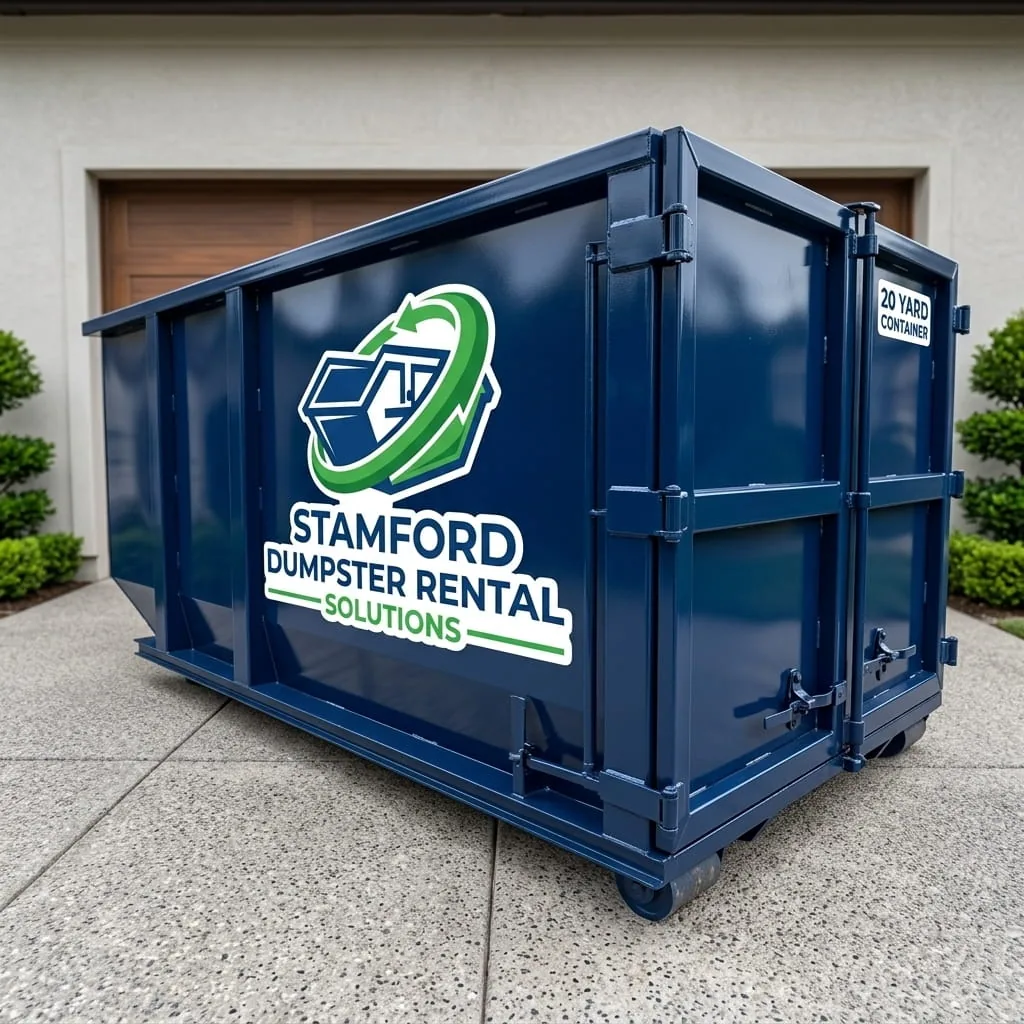
20 yard. Twenty-two feet, three to four tons. The most requested size and right perhaps half the time. Kitchen and bathroom together, a multi-layer asphalt roof, a large garage clearance.
30 yard. Twenty-two feet, six-foot walls, four to five tons. A volume container. Whole-house clearances, framing waste, outbuilding demolition, commercial refits.
40 yard. Eight-foot walls, five to six tons. Commercial work almost exclusively. Loading eight-foot walls by hand is harder than people expect.
Project-by-project recommendations
Single bathroom remodel: 10 yard.
Kitchen alone: 15 yard in an older home, 20 in a newer one.
Kitchen and bathroom together: 20 yard.
Whole-house flooring: 20 yard, and tell us whether it is carpet or tile.
Asphalt roof tear-off: depends on squares and layers. Single layer, 15 yard. Multiple layers, 20 and expect it to look half empty when full.
Slate or tile roof: a 10 yard, level load. Sizing slate like asphalt is one of the more expensive errors available.
Damp basement clearance: one size down from what the volume suggests.
Fully furnished three-bedroom clearance: 30 yard.
Stone wall or patio removal: 10 yard, level, and probably more than one.
Outbuilding demolition: 30 yard.
Office strip-out: 30 or 40 yard depending on floor area.
What the site will and will not allow
Sometimes the material says one thing and the driveway says another, and the driveway wins.
A 30 yard needs around seventy feet of straight approach. A 10 yard needs about forty-five. If the drive curves, the larger container physically cannot be placed however much material you have.
Overhead clearance is the constraint people forget, and in this county it fails more deliveries than anything else. The truck bed rises well above roof height when it tips — roughly twenty-three feet of clear air is needed. Across North Stamford, Riverside, New Canaan and Wilton the mature canopy over the driveways is the single most common reason a truck arrives and cannot place the box.
Inland there is a second one: stone gateposts. A roll-off truck needs about eleven feet of clear width and a lot of older entrances through Wilton, Weston and backcountry Greenwich are narrower than that.
The fix is simple. Stand in the road, photograph the intended spot with the sky in frame, and send it when you call.
Getting the answer in one phone call
Have five things ready and this takes ninety seconds: what the project is, roughly when the house was built, what the main material will be, whether the property has taken water, and a photo of the spot from the road.
You will get a size recommendation and a flat rate covering delivery, seven days, collection and a tonnage allowance. If we think you have asked for the wrong container we will say so, including when that means selling you something cheaper.
Book a container in Stamford
One flat rate covering delivery, seven days, pickup and disposal.
(475) 264-4825Questions readers ask about this
What is the most common dumpster size in Stamford?
The 20 yard is requested most often. The 15 yard is what we actually recommend most often, because so much of the housing across Stamford and the surrounding towns produces dense demolition debris that reaches a weight limit before it fills the container.
Does it matter if my basement has taken water?
It matters a great deal. Damp and flood-affected material can weigh close to double its dry equivalent, and disposal is charged by the ton. Tell us when you book and we will size for wet material rather than let it surface as an overage.
What happens if I go over the weight allowance?
You pay the per-ton overage rate quoted to you at the start and you get a copy of the scale ticket from the disposal facility. Nothing is invented after the fact.
Can I fill the container above the rim?
No. The doors have to close for the load to be legally transported. If material is heaped above the rim we will have to ask you to remove it before we can take the container away.