The Merritt Parkway, and Why Your Delivery Takes a Different Route
No roll-off truck can legally use Route 15. It sounds like trivia until it explains why an inland delivery takes longer and costs more than the map suggests.
In this guide
- The rule
- Why the ban exists
- What counts as a commercial vehicle
- What it means for your delivery
- The routes a truck actually uses
- Why this affects the price
- What to do with this information
This is the piece of local knowledge that separates a company that actually operates in Fairfield County from one that quoted you off a map. It sounds like trivia. It is not.
The rule
Commercial vehicles are prohibited on the Merritt Parkway — Route 15 — along its entire length from the New York state line in Greenwich to Milford. The same applies to the Wilbur Cross Parkway and the Milford Parkway further north.
This is state law rather than a local preference. Connecticut statute defines these roads as parkways devoted exclusively to non-commercial traffic, and the ban is enforced by the State Police. Trailers of every kind are banned as well, including utility and car trailers, along with RVs and buses.
There is an exemption process through the Office of the State Traffic Administration, but it exists for things like roadway work on the parkway itself or genuine life-safety movements. It is not something a waste hauler can use to shorten a run.
Why the ban exists
The Merritt opened in 1938 and it was designed as a scenic road for passenger cars. It is on the National Register of Historic Places, and the bridges — each architecturally distinct — were originally built to a minimum of around eleven feet of clearance at the abutments. Some are lower now because the roadbed has been re-graded over the years.
Eleven feet does not accommodate a truck. The road has sharp curves, short merges and a narrow tree-filled median. It simply was not built for anything larger than a car, and the periodic photographs of a box truck wedged under a Merritt bridge are the predictable result of a driver following a satnav that did not know the rule.
What counts as a commercial vehicle
Broader than most people assume. Any vehicle bearing commercial plates, and any truck used for business, is prohibited. That extends to vehicles carrying advertising or company logos, and to passenger vehicles on combination plates above the weight threshold.
It is also why rental trucks are almost always prohibited — they typically carry commercial or combination plates and exceed the height and weight limits, even when somebody is just moving house. Worth knowing if you are hiring a truck to shift material yourself rather than taking a container.
What it means for your delivery
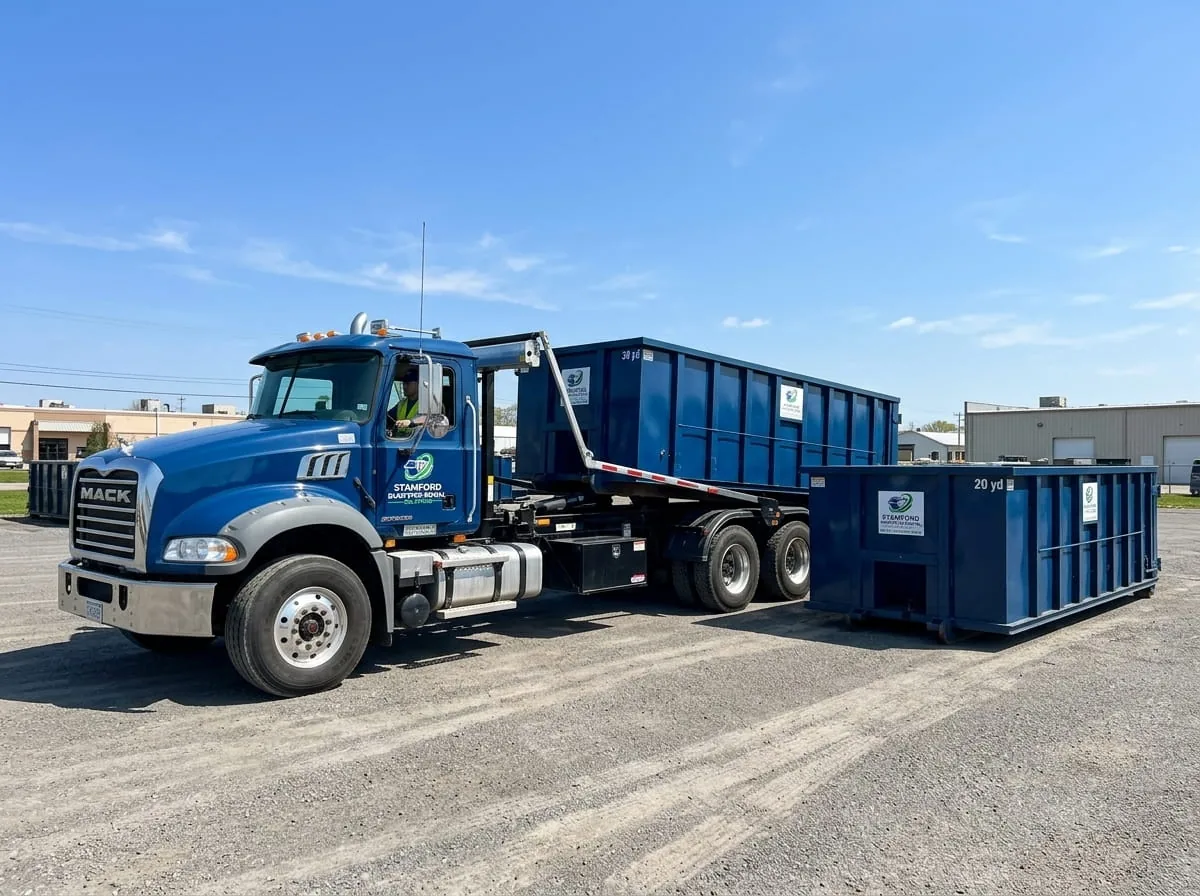
A roll-off truck cannot use the Merritt to reach you. Not on the way in, not on the way out, not loaded, not empty.
That has almost no effect on a job in Stamford, Darien or along the shoreline, because those are I-95 and Post Road destinations anyway. It has a substantial effect on anything north of the parkway: New Canaan, Wilton, Weston, backcountry Greenwich and the northern parts of Norwalk.
Look at a map and New Canaan is nine miles from Stamford. For a container truck it is meaningfully further and slower, because the direct route is unavailable and the alternative is surface roads through town centres.
The routes a truck actually uses
Everything runs on I-95 as the spine, then north on whichever surface road serves the destination. Route 7 up the Norwalk River valley for Wilton and beyond. Route 106 and Long Ridge or High Ridge for New Canaan and north Stamford. Route 57 through Westport for Weston. The Boston Post Road — US-1 — for everything along the shoreline between towns.
Those roads carry local traffic, traffic lights and school-run congestion. A run that looks like fifteen minutes on a straight line can be forty in practice at the wrong time of day.
It is also why we schedule inland deliveries in blocks rather than as individual trips. Sending a truck to Weston, back to the yard, then out to Wilton is a poor use of a day when both could be done on one loop.
Why this affects the price
Time in the cab is the cost. A container going to Wilton or Weston occupies a truck and a driver for substantially longer than one going to Springdale, and that is before the disposal routing is considered.
Any company quoting identical pricing across the whole county either has not worked this out or is averaging, which means shoreline customers are quietly subsidising inland ones. Neither is what you want.
We quote per job with the real run built into the number, which is why a Stamford job genuinely is cheaper than a Weston one and why the quote does not move afterwards.
What to do with this information
Three practical things.
Book inland jobs with more notice. Two to three days is fine for the shoreline. For Wilton, Weston or backcountry Greenwich, more notice gets you into a scheduled run rather than waiting for a gap.
Do not judge a quote on map miles. If someone is much cheaper on an inland town, ask how they are routing the truck. The answer is occasionally interesting.
If you are hauling material yourself, check your plates. A rental truck on the Merritt is a genuine risk rather than a technicality, and the bridges do not negotiate.
Book a container in Stamford
One flat rate covering delivery, seven days, pickup and disposal.
(475) 264-4825Questions readers ask about this
Can any dumpster truck use the Merritt Parkway?
No. Commercial vehicles are banned along the entire length of the Merritt under Connecticut law, and the bridges are too low for trucks in any case. Any company suggesting otherwise is either mistaken or not routing its own trucks.
Does this make inland deliveries more expensive?
It makes them longer, and time in the cab is a real cost. A New Canaan or Wilton run takes considerably more than the map distance suggests because it goes via I-95 and the surface roads. We build that into the flat rate rather than adding a surcharge later.
Can I take a rental truck on the Merritt to haul my own debris?
Almost certainly not. Rental trucks usually carry commercial or combination plates and exceed the height and weight limits, so they are prohibited even for a personal move. The low bridges are not a technicality.
How much notice do you need for an inland town?
More than for the shoreline. Two to three days works anywhere, but for Wilton, Weston or backcountry Greenwich, booking further ahead gets you into a scheduled run rather than waiting for a gap in the day.